
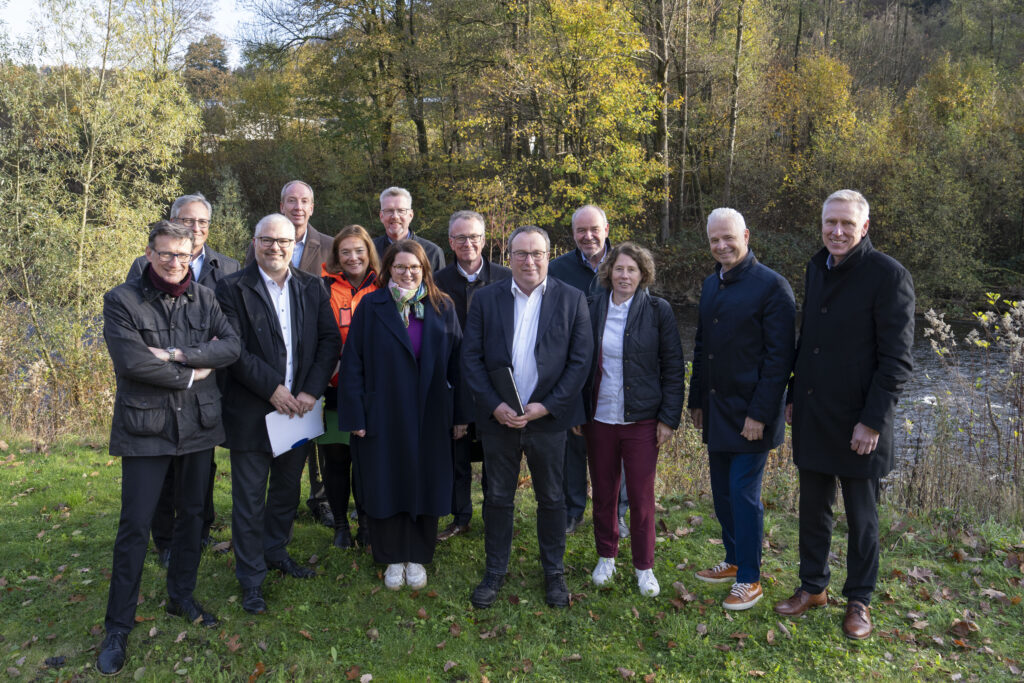
On 10 November, the renatured Wupper in Wuppertal-Laaken and the Wupper Reservoir provided an impressive backdrop for a meeting between the chairpersons and board members of the water associations in North Rhine-Westphalia and the State Environment Minister, Oliver Krischer. The annual exchange offers an opportunity to discuss water management challenges as well as current projects and developments on-site at one of the associations.
The Wupperverband, which is celebrating its 95th anniversary this year, presented the renaturation project, jointly implemented in 2017/2018, with the family-run company Vorwerk. The special aspect: the Wupper was excellently integrated into the former factory expansion at Vorwerk's production site. It flows right through the site and could be nature-recreated for over a kilometre and, in places, widened by one and a half times. A win-win situation, as the Wupperverband was able to create natural river structures on the one hand and give the Wupper more space at the same time. This had a positive effect during the extreme flood in 2021, with less damage occurring in this area.
The renaturalisation and nature-based design of the Wupper is supported by the state of North Rhine-Westphalia with funding.
„The example of this renaturation in Laaken – which is representative of many similar projects undertaken by NRW water associations – clearly demonstrates that river development and green flood protection go hand in hand. We are strengthening the river, promoting biodiversity in the ecosystem, and at the same time making our rivers more resilient to the consequences of climate change, from floods to droughts,“ says Ingo Noppen, member of the Wupperverband's executive board. „Our rivers need space. Therefore, it is important that committed companies – like the Wuppertal-based direct sales company Vorwerk in this instance – provide land for river development. We can see the success of this joint project. For example, the kingfisher, a symbol of an intact river landscape, can be regularly observed here.“
Water management stands for forward-looking management of our water resources. It thus creates positive development momentum and contributes significantly to climate, environmental, and resource protection in the country. At the same time, water management is undergoing a profound transformation – technological, social, and ecological – in order to meet the challenges of climate change, the demands of digitalisation and demographic change. A crucial step, therefore, is for the Ministry of the Environment to actively support water associations on this path and create the right framework conditions to successfully master the coming tasks.
By legal mandate, water management associations are responsible for holistic river basin management and thus for the conservation and improvement of water resources in their respective river catchment areas. Their tasks include, in addition to wastewater disposal, balancing water levels during floods and dry periods, and monitoring groundwater levels in active and former mining areas. They also take care of the maintenance and renaturation of rivers, as well as the protection and provision of the necessary water resources for drinking water production.